
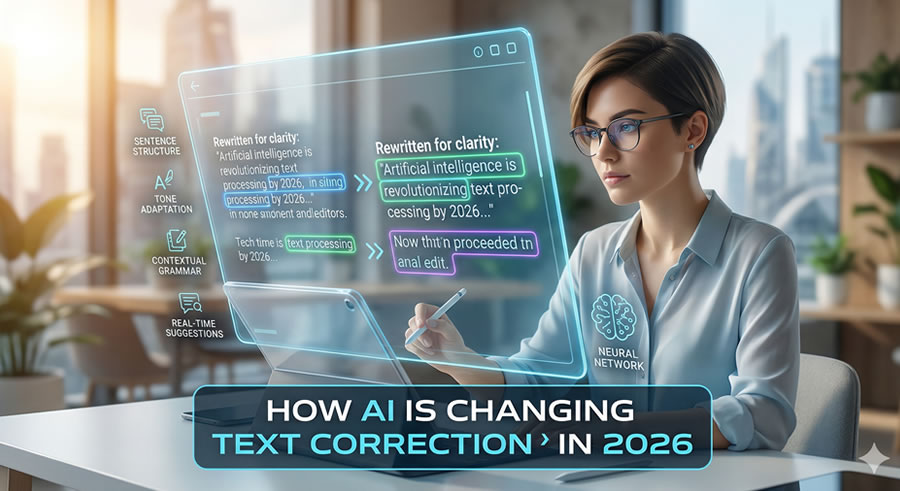
For most of human history, catching a typo meant reading your own words twice and hoping your brain did not skip over the mistake the same way it made it. Then came spell-checkers, which helped, but only barely. They flagged “teh” and let “their” slide when you meant “there.” Grammar tools improved things further, yet they still felt mechanical, rigid, and frequently wrong in ways that were almost insulting. By 2025, all of that has fundamentally changed. Artificial intelligence has not simply upgraded text correction — it has reimagined what correction even means.
The shift started gradually, then arrived all at once. Early AI writing assistants learned from enormous bodies of text and could begin to understand context, not just rules. Instead of checking whether a word existed in a dictionary, they could evaluate whether a word made sense given everything around it. That distinction — rules versus understanding — is the core of what separates modern AI correction from everything that came before it.
Today, AI-powered Spell Check tools correct text the way a skilled human editor would, by reading for meaning first. When you write “the meeting was moved up to Thursday,” an old-school grammar checker has nothing to flag. But a modern AI assistant understands that “moved up” is ambiguous — it could mean the meeting is now earlier or later depending on the reader’s interpretation — and can surface that ambiguity as a potential issue. This kind of contextual intelligence was unimaginable in mainstream tools just a few years ago.
Speed has become another defining feature of 2025-era correction. AI models now run fast enough to analyze text as it is being typed, character by character, inside any application — browsers, email clients, word processors, messaging apps. Users no longer need to finish writing and then run a check. The correction happens in real time, invisibly, the way autocomplete once did but with far greater accuracy and far less frustration. The experience is less like using a tool and more like having a thoughtful colleague reading over your shoulder who never gets tired and never misses a beat.
Multilingual correction is another area where AI has created a genuine leap forward. Legacy tools required separate language packs and often performed poorly on anything outside a handful of major European languages. Modern AI models handle dozens of languages with comparable quality, and some are now capable of correcting text that mixes languages within the same sentence — a common reality for bilingual and multilingual writers that older software simply could not handle gracefully.
There is also a growing sophistication around tone and audience. Correction in 2025 is not just about grammatical accuracy; it is about fit. AI tools can now assess whether a piece of writing sounds appropriate for its intended context — formal enough for a business proposal, casual enough for a social post, clear enough for a general audience. Some tools allow users to define a target tone or style, and the AI adjusts its suggestions accordingly. This moves correction out of the purely technical domain and into something that starts to resemble genuine editorial judgment.
For professionals who rely on written communication — which is nearly everyone — this represents a quiet but profound shift in daily work. Emails that once required a second read before sending now go out with confidence. Reports that once needed a proofreading pass now arrive polished from the first draft. Non-native speakers of a language can write in that language with a level of fluency that would have required years of additional practice to achieve on their own.
None of this means human judgment is obsolete. AI correction tools still miss things, still misread irony, still occasionally suggest changes that flatten the voice out of a piece of writing. The best results come when writers stay engaged with the suggestions rather than accepting them blindly. But the baseline has risen dramatically, and the floor — the minimum quality of a corrected piece of text — is higher than it has ever been.
What 2025 makes clear is that text correction has stopped being a technical afterthought and has become a core part of how AI assists human communication. The tools have grown subtle enough to feel natural and powerful enough to matter. For anyone who writes — and in the modern world, that is nearly everyone — the difference is already being felt every single day.